Introduction
If you’ve ever tried to scale cloud phones beyond a handful of devices, you already know the real risk isn’t price or UI—it’s collapse under scale. Accounts start dropping. Sessions reset unexpectedly. Performance becomes unpredictable.
That’s why the question of GenPlay vs Redfinger—or any other cloud phone brands like Vsphone, Ugphone, or LDCloud—has become especially important right now.. This isn’t about features, It’s about which cloud phone can stay stable, trusted, and controllable when you run it day after day, at real volume.
This article looks at cloud phones from an operator’s point of view: long-term automation, multi-account operations, and systems that must run 24/7 without surprises.
GenPlay scales safer for long-term use
GenPlay scales safer because it relies on real, hardware-isolated devices rather than shared virtual environments, reducing detection risk, instability, and unpredictable resets over long-term operations.
What “scales safely” means in cloud phones
Scaling safely doesn’t mean “adding more devices.” It means adding devices without increasing risk proportionally.
In real operations, safe scaling usually comes down to four factors:
- Device authenticity (how real the phone looks to platforms)
- Infrastructure isolation (blast radius when something fails)
- Performance consistency over time
- Control over resets, downtime, and identity changes
Most users don’t hit problems at 5–10 phones. They hit problems at 50, 100, or 300—when small weaknesses turn into systemic failures.
Why scaling risk matters more than price
Cheap cloud phones often look attractive early on. The cost problem shows up later.
A single forced reset across dozens of devices can wipe weeks of warm-up. A detection wave can burn entire account batches. At scale, risk compounds faster than cost savings.
Operators who stay profitable long term usually optimize for:
- Lower variance, not lower monthly fees
- Predictability, not peak specs
- Fewer “surprises,” not faster setup
Why many cloud phone setups break at scale
Most cloud phone setups fail at scale because virtualization, shared infrastructure, and centralized control amplify detection risk and operational instability as device count increases.
Emulator-based environments increase detection risk
Many cloud phone platforms rely on virtualization or emulator-like layers. Even when marketed as “cloud phones,” these environments often share underlying resources.
Common consequences:
- Similar hardware fingerprints across devices
- Repeated system-level signals
- Higher correlation between accounts
At small scale, this may never surface. At large scale, patterns emerge—and platforms are very good at spotting patterns.
I’ve seen teams run smoothly for weeks, then lose dozens of accounts within hours because all devices shared the same underlying environment.
Centralized cloud phones amplify account exposure
Centralization is convenient, but it’s also dangerous.
When devices depend on the same backend:
- A single outage affects everyone
- Forced updates apply globally
- Network or system changes propagate instantly
In one real case, a centralized cloud update caused mass reboots across a phone farm overnight. No bans—but weeks of behavioral data were lost.
How cloud phone architecture impacts scalability
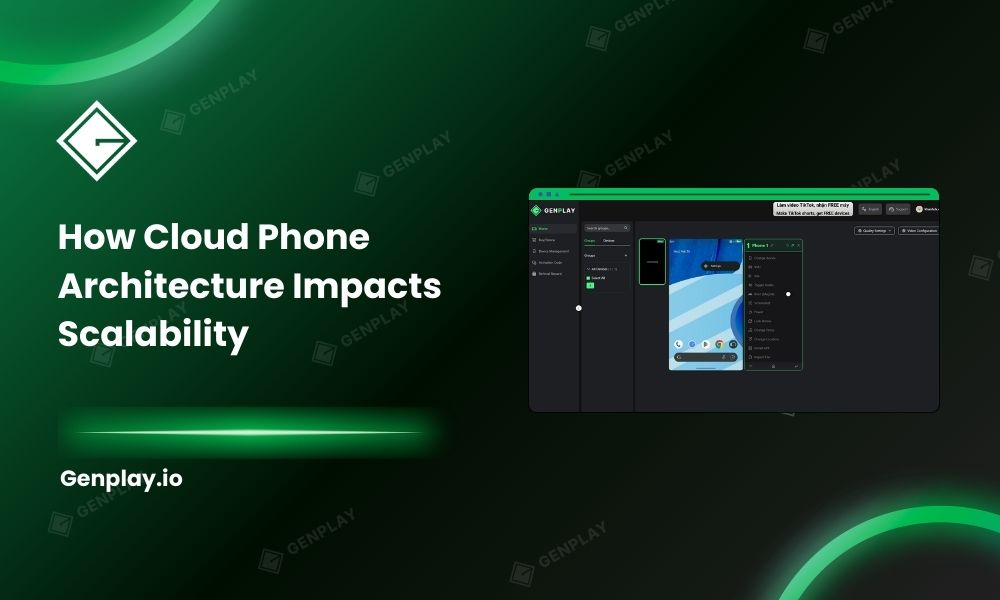
Architecture determines whether scaling increases capacity or multiplies risk, with real-device isolation offering far more predictable outcomes than virtualized instances.
Real-device cloud phones vs virtual instances
The core architectural difference is simple:
- Real-device cloud phones run on physical phones
- Virtual instances simulate phones in shared environments
With GenPlay, each device behaves like an independent phone, because it is one. There’s no shared kernel pretending to be many phones.
Virtual instances are efficient. They’re also inherently correlated.
This distinction matters more as your operation grows.
Hardware isolation and long-term stability
Hardware isolation changes failure dynamics.
If one real device fails:
- One device resets
- One account is affected
If one virtual node fails:
- Many devices reset
- Many accounts are affected
That’s why hardware isolation tends to feel “boring” in a good way. Less drama. Fewer cascading issues. More boring days are exactly what long-term operators want.
GenPlay vs Redfinger under real-world scaling needs
Under sustained, large-scale usage, GenPlay’s real-device infrastructure offers higher authenticity and stability, while Redfinger functions better as a general-purpose, entry-level cloud phone.
Infrastructure design and device authenticity
Here’s the neutral reality:
- GenPlay uses real, isolated devices
- Redfinger relies on cloud-based, virtualized environments
This doesn’t make Redfinger “bad.” It makes it different.
Redfinger works well for:
- Short-term tasks
- Small batches
- General app access
When authenticity and long-term trust signals matter, real hardware has structural advantages that virtualization can’t fully replicate.
Performance consistency over time
Long-running operations expose weaknesses quickly.
In practice, operators report that real-device setups:
- Run 24/7 with fewer forced resets
- Maintain more consistent performance over weeks
- Experience fewer unexplained slowdowns
Virtual environments can perform well—but performance variance tends to increase over time, especially under continuous automation loads.
What experienced teams prioritize when choosing
Experienced teams prioritize predictability, isolation, and control over convenience, especially once operations exceed dozens of devices.
When entry-level cloud phones stop being enough
Platforms like Redfinger are often where teams start. They’re accessible, easy to test, and inexpensive.
The transition usually happens when:
- Device count grows beyond 50+
- Accounts represent real revenue
- Downtime becomes costly
At that point, teams stop asking “Does it work?” and start asking “How often does it fail—and how badly?”
Why serious operators favor infrastructure-first platforms
Infrastructure-first platforms are designed around failure containment.
Instead of asking:
- “How fast can we spin up devices?”
They ask:
- “What happens when something goes wrong?”
GenPlay’s design reflects that mindset: fewer shared dependencies, more isolation, and better control over long-term behavior.
Choosing the right cloud phone for safe scaling
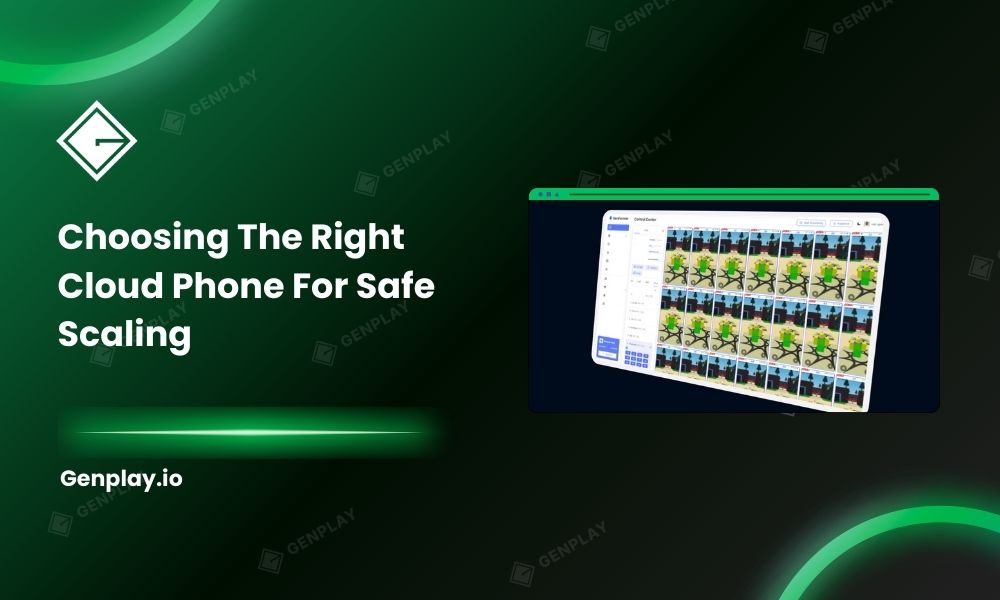
The right cloud phone depends on whether your priority is convenience at small scale or stability at sustained, large-scale operations.
Teams running long-term automation
If you’re running MMO, marketing automation, AFK workflows, or Web3 tasks that operate continuously, stability matters more than setup speed.
Real-device infrastructure reduces:
- Behavioral correlation
- Reset frequency
- Long-term trust degradation
Operations managing many accounts or devices
At 50–500+ devices, management overhead becomes real risk.
Hardware-isolated systems:
- Fail more gracefully
- Scale more linearly
- Are easier to debug when issues appear
Businesses prioritizing stability and control
Businesses tend to prefer systems that behave predictably under stress.
That usually means:
- Fewer shared dependencies
- Clear operational boundaries
- Infrastructure built for endurance, not demos
When people compare GenPlay vs Redfinger, they’re often really asking a deeper question: Do I want convenience now, or stability later?
Redfinger fits well as a general, entry-level cloud phone. GenPlay is built for teams that need real devices, long-term consistency, and safe scaling without surprises.
If your operation is growing—and staying alive matters more than spinning up fast—choosing infrastructure designed for real-world scale isn’t a luxury. It’s risk management.
If you’re exploring how real-device cloud phones work in practice, start by understanding your scaling horizon and tolerance for instability. The right choice becomes clearer once those are defined.
GenPlay – Real Device, Real Performance, Real Profit
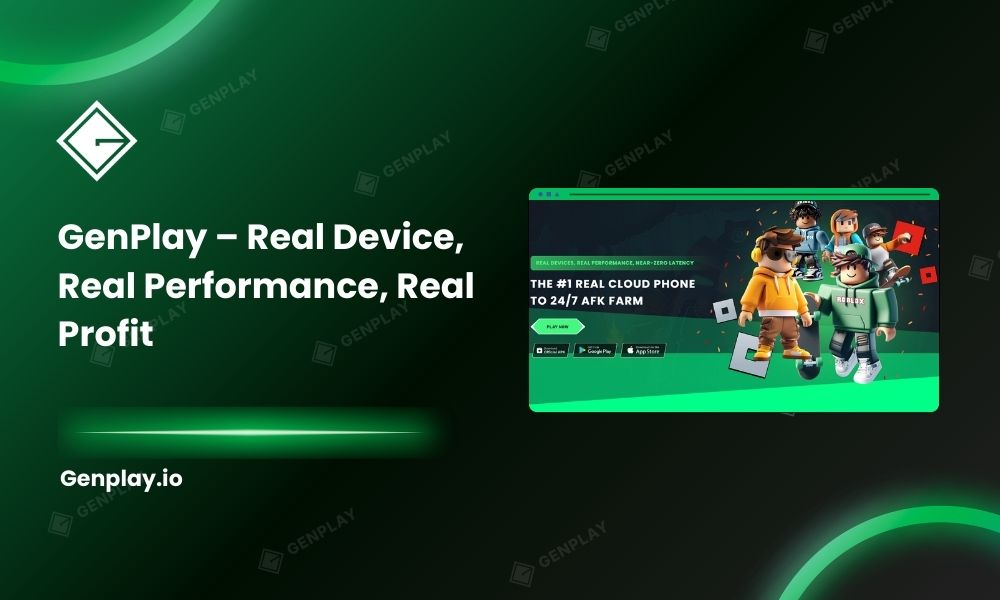
It’s time to upgrade to GenPlay — a 100% real-device cloud phone platform from the Gen Ecosystem built for serious performance, proprietary ROM optimization, strong security, true 120 FPS gameplay, and high ROI with full game compatibility.
Developed by GenFarmer – Leading Vietnamese Technology
GenPlay is fully developed in Vietnam by the GenFarmer team — the company behind recognized platforms such as GenLogin, Box Phone, GenRouter, and Package.
With over three years of R&D, GenPlay became Vietnam’s first physical cloud phone infrastructure, built to compete directly with large-scale providers in Asia.
This is not a resold virtualization service. It’s vertically integrated hardware infrastructure designed in-house.
100% Real Performance – Independent Snapdragon Chips, Smooth 120 FPS 24/7
Unlike virtualized cloud phones:
- Every GenPlay device is a real Android phone
- No virtualization layer
- Dedicated CPU, RAM, and GPU — no shared resources
- Powered by Snapdragon chips for stable high performance
- Up to 120 FPS with high resolution and near-zero latency
The result: Gameplay that feels identical to using a physical phone in your hand.
No Bans, High Security – Custom ROM + Dedicated Proxy
GenPlay runs on a custom-built ROM developed by GenFarmer, optimized to reduce emulator detection risks.
- Recognized as real devices by games
- Reduced account lock or suspension risk
- Dedicated proxy per device
- IP, language, and timezone aligned like a local device
- Full compatibility across mobile games
Unlike virtual environments that may trigger detection layers, GenPlay operates at the hardware level.
Market-Competitive Pricing – Multiples in Performance
GenPlay offers pricing comparable to — or lower than — many virtual cloud phone services, while delivering significantly higher performance.
- No large upfront hardware purchase
- Monthly subscription flexibility
- Scale up during events, scale down when not needed
- Pay only for what you run
It’s built for operational flexibility without heavy capital investment.
24/7 Continuous Operation – No Overheating, No Battery Degradation
GenPlay’s hardware and cloud infrastructure are optimized for long-term continuous operation.
- Minimized disconnects, lag, and crashes
- Designed for AFK, MMO, and automation workflows
- No overheating issues
- No battery degradation like home physical devices
- Account settings saved instantly without repeated setup
Run day and night without babysitting your devices.
Try GenPlay Now!
🎮 Farm comfortably. Run AFK with confidence. GenPlay handles the infrastructure!
- Sign up via the App or Join our Discord community to receive free trial promotions.
- Download GenPlay on Google Play

GenPlay Social Hub
- Fanpage: https://www.facebook.com/genplayvietnam
- Group: https://www.facebook.com/groups/genplayvietnam
- YouTube: https://www.youtube.com/@GenPlayOfficial
- Telegram: https://t.me/GenPlayVNOfficial
If you’re unsure where to begin, CONTACT GENPLAY TEAM, we’re ready to help you build a stable, scalable setup!